Roquefort Cheese
Roquefort cheese is one of the oldest cheeses made in France and there are references to this moldy delicacy dating back almost 2000 years! That is a lot of tradition and this gourmet cheese is rightfully considered one of France's national treasures.
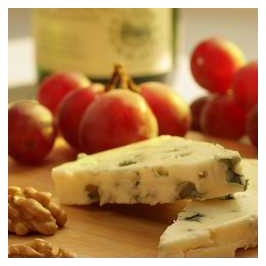
Description
- Rindless, white cheese with dark green veining.
- Slightly crumbly, yet humid and quite soft, melting easily in the mouth.
- Tangy, salty, pronounced taste. Not a shy cheese!
Roquefort Cheese History
Like so many foods in France, there is a delightful story that goes along with the pleasure of eating Roquefort. Legend has it that the cheese came into existence by a happy accident. A young and lustful shepherd stowed his lunch in a handy cave and abandoned his flock to pursue a pretty maiden that happened by. He forgot about his lunch until several weeks later when he returned to the cave to find his cheese and bread covered with a layer of bluish green mold. Being a hungry and practical sort of lad, he ate the cheese anyway and found it to be notably delicious.
The French king Charlemagne also played an important role in the history of Roquefort. It is said that he was passing through the region of Aveyron, when he was served a moldy cheese by his host. The king carefully set about cutting off the unappetizing parts of the cheese, until his host dared explain to him that the mold was what gave this cheese all its flavor. Charlemagne found the cheese to be so much to his liking that he requested that cartloads of Roquefort cheese be sent to his residence in the north of France every year.
Roquefort has been recognized with an AO (appellation d'origine) since 1925 and an AOC (appellation d'origine controlée) since 1979. This appellation means that in order to be labeled Roquefort, a cheese must meet certain strict criteria. Among other stipulations, Roquefort cheese can be made only from the milk of sheep that graze in a designated area centered around the village of Roquefort-sur-Soulzon, and it must be aged in the natural caves found near this same village.
A Few Facts
- Roquefort's green veins are made by introducing a mold (Penicillium roqueforti) into the cheese. Once upon a time bread was left in the Roquefort caves where it would develop the necessary mold, but in modern times it is cultivated in a laboratory.
- Roquefort cheese is made in cylinders weighing up to about six pounds, and is typically sold in half cylinders or smaller slices.
- A one ounce serving of Roquefort contains about 100 calories, six grams of protein, and about 20 percent of the RDA for calcium.
- There are just seven companies that make Roquefort, all located in the village of Roquefort sur Soulzon. Le Roquefort Société is the largest producer.
Serving Roquefort
- As with most cheese, Roquefort should be eaten at room temperature. When it is cold, cheese modestly hides its full flavors, so be sure to give it time to warm up, relax and express itself.
- Being a strong cheese, Roquefort can handle a strong accompaniment. Most people enjoy a sweet wine with this assertive cheese and some popular recommendations are: Sauternes, Monbazillac, and even Porto.
- It can be spread on grilled French bread and is also nice accompanied with fruits: fresh figs, grapes and nuts are often served alongside it.
- Roquefort marries well with so many flavors, that it is a popular ingredient in recipes. Try it in this blue cheese and pear salad or make it into this blue cheese sauce recipe for a superb accompaniment to red meats.
Substitutes
Of course there is nothing like the real thing, but with the recent (January 2009) import tax placed on Roquefort in the US, you may be unable to find it, especially at a reasonable price. While waiting for the politicians to sort this one out, you can enjoy one of the many other excellent blue cheeses available for your cheese platters. And try substituting the Italian cheese Gorgonzola wherever you would like the tangy taste of Roquefort in your recipes.
Return to French Cheese.
New! Comments
Have your say about what you just read! Leave me a comment in the box below.